
Delphi 7 shipped in August 2002 and became, by multiple subsequent surveys, the version a plurality of working developers refused to abandon.
What Delphi 7 Actually Contained
Delphi 7 Studio arrived as the last release under Borland's undivided ownership before the CodeGear interlude, and its feature list was measured rather than spectacular. The VCL gained Themes support, wrapping Windows XP's visual styles through a manifest mechanism. The IDE gained a handful of modest refinements to its everyday tooling rather than any sweeping redesign. Compiler performance improved, documentation was thorough, and the runtime libraries were stable. Nothing in that list reads as revolutionary.
The deeper story is what the release lacked: it carried no forced framework transition, no experimental cross-platform layer, no half-finished port. Its predecessor, Delphi 6, had introduced CLX (Component Library for Cross-platform) — the Qt-backed library designed for both Windows and Linux — and developers who had no Linux ambitions found themselves navigating a split component world. Delphi 7 did not remove CLX, but it restored the VCL to unambiguous primacy and delivered a Windows IDE that felt finished. That sense of settledness proved more durable than any individual feature.
What the Surveys Measured
The preference did not become visible until later versions gave developers a reason to keep looking backward. Delphi 8, released in late 2003, targeted the .NET runtime exclusively, abandoning native Win32 compilation for that cycle. Delphi 2005 restored both targets but shipped with an IDE widely reported as slow and unstable. The Delphi Magazine ↗ community and independent polling conducted by sites tracking Object Pascal usage began, from roughly 2005 onward, to record a stubborn concentration of respondents still citing Delphi 7 as their primary compiler.
The surveys were not measuring nostalgia. They were measuring stability under a business cost. A development shop running Delphi 7 owned a perpetual licence for a compiler that generated compact, fast, dependency-light Win32 executables. The VCL component ecosystem accumulated through the 1990s — from vendors including DevExpress and TMS Software, and from the open community work organised through JEDI — was entirely compatible. Upgrading meant retesting that ecosystem, absorbing licence costs, and accepting an IDE whose quality signal in the 2003–2006 window was poor. The surveys captured that calculation rather than sentiment.

The VCL's depth is the point: a form arrives with several generations of ancestor behaviour already linked into it.
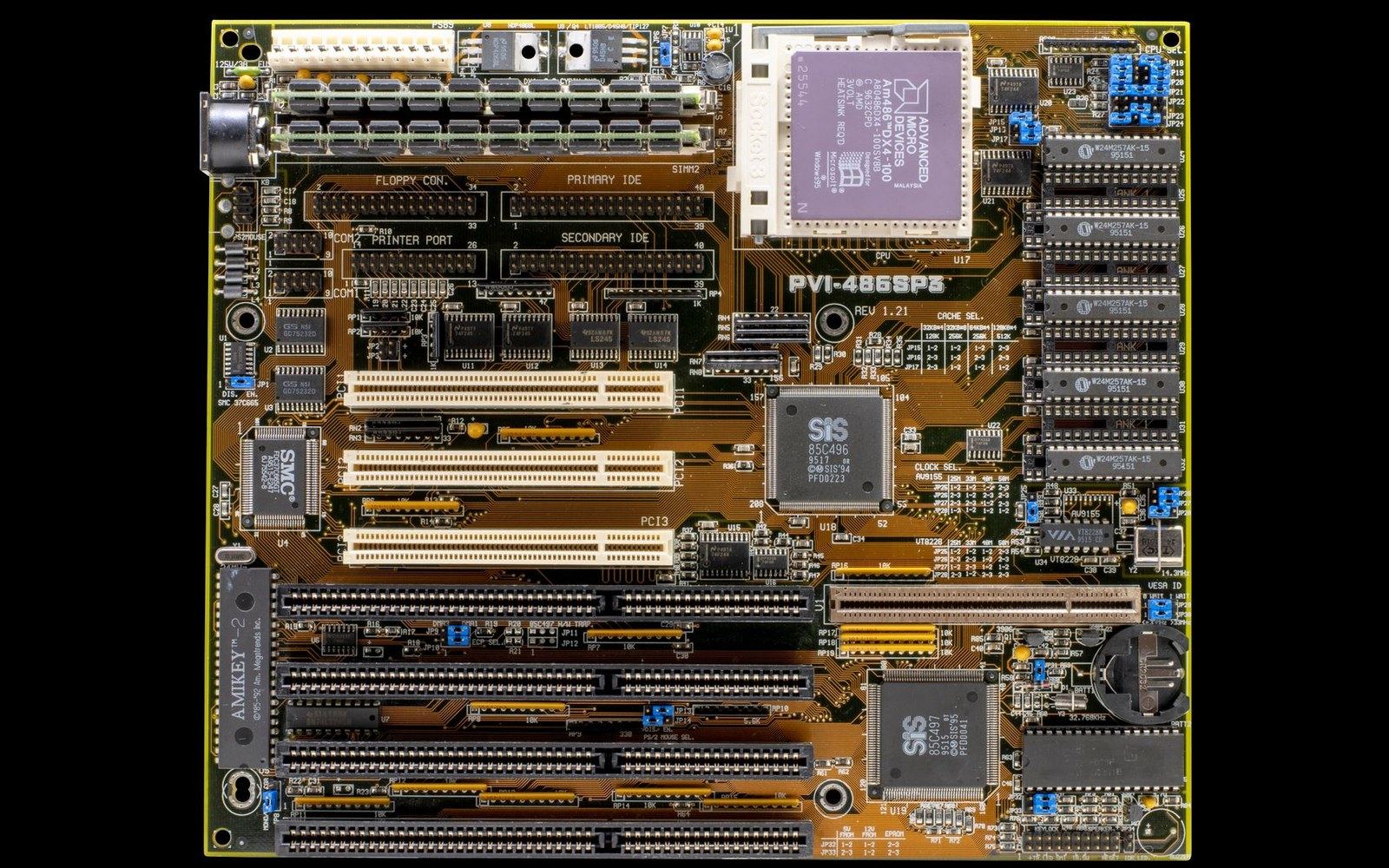
Mid-1990s PC hardware is what the size argument was made against: a machine measuring its memory in megabytes, not gigabytes.
Photo: Nicolas Foster / Pexels
By the time Embarcadero Technologies acquired the Delphi product line in 2008, the Unicode migration in Delphi 2009 created a second, harder barrier: the shift from AnsiString to UnicodeString as the default string type broke source compatibility across a wide class of legacy code. Developers who had survived Delphi 8's .NET disruption on Delphi 7 now faced a string-model rupture as the price of admission to the current compiler. Some crossed; many did not. Survey data from the late 2000s and into the 2010s continued to surface Delphi 7 as a reference point — not always as the primary tool in use, but as the benchmark against which later versions were argued.
Why a Compiler Becomes a Fixture
The phenomenon has a precise analogue in other language communities — gcc versions pinned by embedded teams, Python 2.7 retained past end-of-life — but the Delphi 7 case has a particular sharpness because the product was commercial. Borland's pricing and release model meant that each upgrade carried a tangible cost, and the value proposition of each successor had to clear a bar set by a version that already worked. According to documented community discussion in venues including the Embarcadero developer forums and the Stack Overflow developer surveys ↗ that began tracking language and toolchain preferences in 2011, Delphi as a whole retained a professional user base well past the point mainstream commentary predicted its disappearance, and within that base the Delphi 7 cohort was identifiable for a full decade after the version shipped.
What Delphi 7 demonstrated, ultimately, is that the most important feature a development tool can ship is a release its users can trust.
More in Delphi