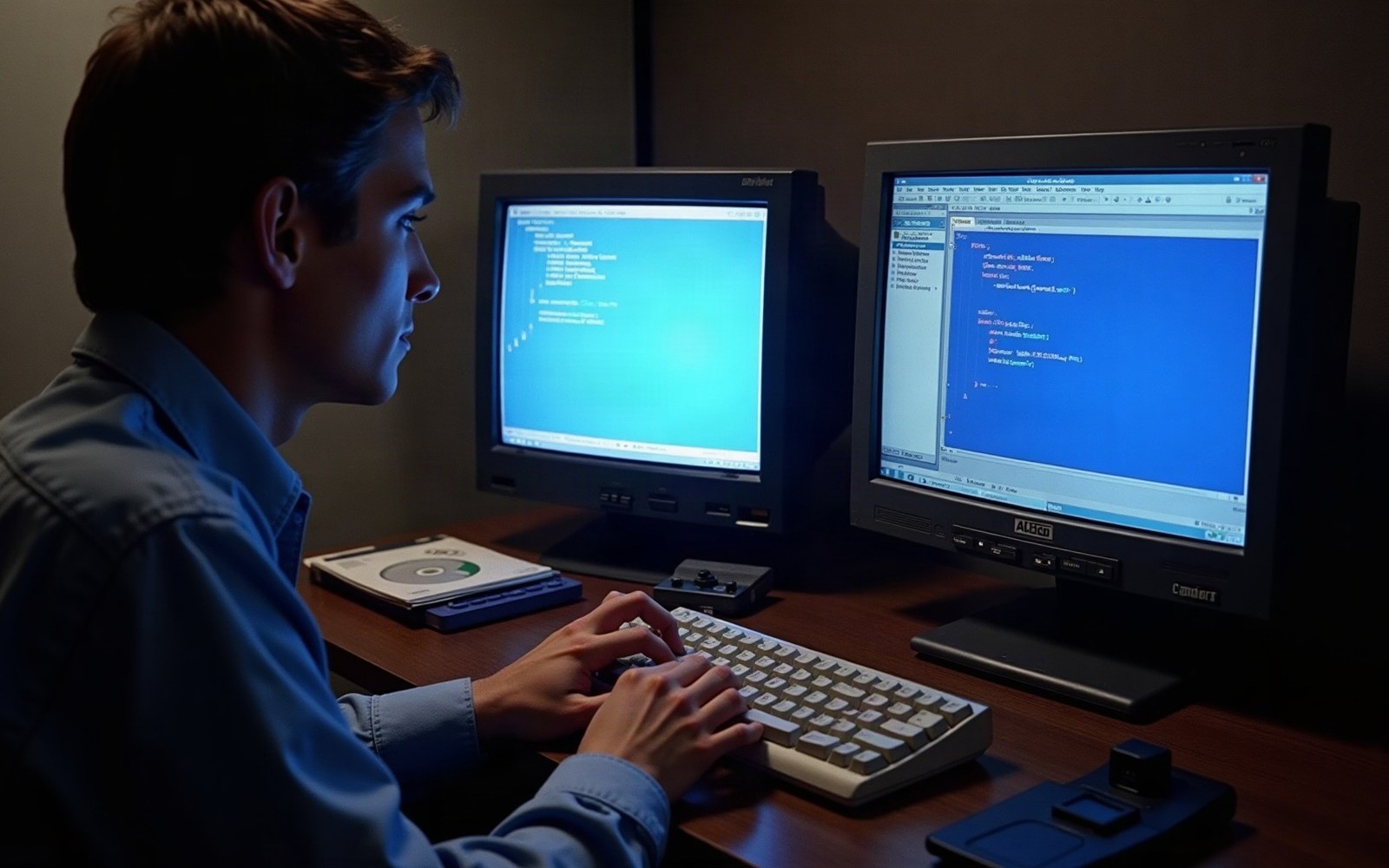
Seven major versions in as many years: Borland's pace through the 1990s and into the 2000s showed what the company thought it was racing against.
The First Half: Establishing the Platform
Delphi 1 arrived in February 1995, running on 16-bit Windows 3.1 and introducing the visual form designer, the Object Pascal compiler, and the VCL (Visual Component Library) in a single release. The combination was new enough to require a name: Rapid Application Development. Borland priced the Standard edition at $99 and the Client/Server edition at $2,499, signalling from the start that it was selling to two distinct audiences — hobbyists and enterprise shops — simultaneously.
Delphi 2 followed in February 1996, barely twelve months later. The shift to 32-bit Windows 95 and NT was the headline, but the release also brought long strings via AnsiString, multi-threaded support improvements and an enhanced debugger. The pace was deliberate: Microsoft had shipped Visual Basic 4 in late 1995, and Borland treated every calendar year without a new Delphi as ground ceded.
Delphi 3, released in 1997, introduced COM and ActiveX authoring from within the IDE, making it possible to build and consume OLE Automation servers directly in Object Pascal. Decision Cube — a pivot-style data analysis component set — appeared in the Professional and Client/Server editions, aimed squarely at the data-warehouse market that was expanding rapidly through the late 1990s. Interfaces as a first-class language feature also debuted here, enabling cleaner COM integration without raw pointer arithmetic.
The Second Half: Ambition and Consolidation
Delphi 4, in 1998, extended the IDE's drag-and-drop capabilities and added dynamic arrays to the language — a long-requested feature that had forced developers to manage heap memory manually or adopt third-party alternatives. Package management via BPL (Borland Package Library) files matured enough in this release to support a genuine third-party component ecosystem; suppliers such as DevExpress and TMS Software were already shipping component suites by this point. MIDAS (Multi-tier Distributed Application Services), introduced in the previous release, was extended in this one as Borland's answer to n-tier architectures, though its licensing cost attracted criticism.
A parts store rather than a code library, but the same premise — take a standard piece off the shelf instead of making one.
Photo: Charlie Merrow / Pexels
Delphi 5, in 1999, is remembered as a stabilisation release in the best sense. The IDE gained a translation repository and team-development features; the debugger was refined; and the overall version became one that shops running Delphi 4 were willing to pay to adopt. The Delphi Magazine, which had been publishing since 1995, reflected a community that was productive and largely satisfied — a contrast to the instability complaints that had accompanied Delphi 4's launch.

The CRT is the era's one constant: everything in this section happened on a screen this shape.
Photo: cottonbro studio / Pexels
Delphi 6, released in 2001, represented Borland's most ambitious architectural gamble of the cycle. The company shipped CLX (Component Library for Cross-platform) alongside the VCL, allowing code to target both Windows and Linux through Kylix — a bet on Linux adoption in enterprise development that did not pay off as anticipated. WebSnap added a server-side web framework, and web services via SOAP became a first-class citizen. The cross-platform ambition, though ultimately unsuccessful as a market story, forced structural discipline into the VCL codebase that outlasted the experiment.
Delphi 7, shipped in August 2002, closed the sequence. It added ECO (Enterprise Core Objects), Borland's model-driven development framework, and bundled IntraWeb for web application development. The compiler itself received optimisation improvements, and the IDE stability that had been iteratively improved since Delphi 5 reached a level that many in the community documented ↗ as a preference they maintained for years afterward — choosing Delphi 7 over subsequent releases well into the following decade.
What the Pace Reveals
Seven releases across seven years — 1995 to 2002 — averaged roughly one major version every twelve months. The rhythm was not accidental; it matched Borland's competitive posture against Visual Basic and, increasingly, Java. When the pace slowed after Delphi 7, the reasons were partly organisational: Borland was investing in cross-language tooling under the new IDE platform it called Galileo, and Delphi was no longer the sole focus. The seven-year sprint remains the period in which Object Pascal's reach was widest and its toolchain most actively contested.
More in Versions